I Was Going To Make a Double-Feature Recommendation, Now I Just Feel Gross
Ceci n'est pas du content.
This is my second blogpost. In the last few weeks, I've amassed a sprawling list of future articles, started an account on NetGalley in the vain hopes that one day someone might find me worthy of giving me the occasional ARC, and devised a plan for monetization that likely won't become necessary for years. I've done hours of academic research for my upcoming essay, attempted to cultivate some kind of professional online presence, and come up with several monthly column ideas to keep the mill running. All of this has been done on top of both a full-time job and writing my first novel.
Among those monthly columns is what you’re reading now: a series of short recommendations for double bill pairings. My inaugural Double Bill was intended to be Vampire’s Kiss (1989) and Black Swan (2010). Then Black Swan director Darren Aronofsky released "his" AI-generated "film" about the American Revolution.
What follows is what I had drafted prior to the unveiling of this skidmark:
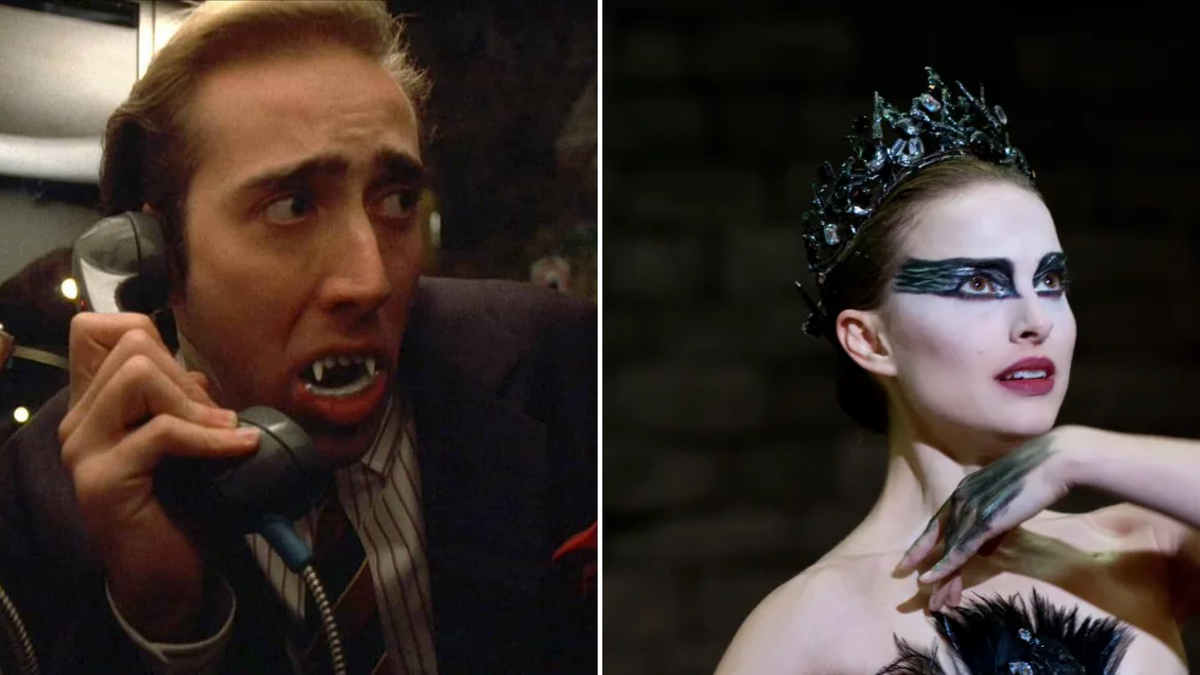
VAMPIRE’S KISS (1989) dir. Robert Bierman
Nicholas Cage stars as a nightmare boss who suffers a break with reality and becomes convinced that he is transforming into a vampire.
BLACK SWAN (2010) dir. Darren Aronofsky
Natalie Portman stars as a ballerina who suffers a break with reality when her director taps her to play the leading dual role in Swan Lake.
I can’t fault people for invoking American Psycho when Vampire’s Kiss comes up. I’d argue, however, that its Cageian excesses shine far brighter when set in relief with Darren Aronofsky’s OTT visions of womanhood on the edge. The movies are both about the pressures of workplace performance taken to violent, absurdist extremes—one from the perspective of the enforcer who creates the problem for his employees, the other from the employee buckling under the strain of the demands placed upon her. Together, the films create a parable in which boss and prole are locked together in a body horror journey they cannot escape, as Natalie Portman remolds herself into the thing her director demands she become, and Nicholas Cage discovers he is the monster he always was. Our bosses are cracking too, we learn—but this only heightens the danger they pose to us, the people who serve them.
I don't know, dude. It's a bitter exercise in irony to be a creative in 2026. You pore over ways to monetize your takes, all the while questioning how much time this work is taking away from your "real" writing (and what's real writing anyway? if a writer posts an article and it gets no clicks, did they really write it?). Walk through the internet and you'll hear billions of artists screaming LOOK AT ME, MAKE ME REAL to the cold stars. What I'm saying here is I am scraping my skull raw in search of content that could lead to an audience for a book that's not yet finished, embarking on a venture that I know perfectly well is unsustainable, and here comes established, lauded auteur Darren Aronofsky with his creepy, coprophagic non-art that is powered by the labor of desperate creatives like myself. Has Aronofsky ever offered us anything we couldn't get somewhere else? Satoshi Kon, director of Perfect Blue (1997), spoke extensively about what he considered to be Aronofsky’s plagiarism of his work in Requiem for a Dream. You can only imagine what he would have said had he lived to see the premiere of Black Swan, which is really just Perfect Blue with a dash of Persona on top. "Aronofsky's" AI-generated Revolutionslop is the logical conclusion to a career that has been rewarded for recycling the work of others.
I wrestled with whether to scrap this essay entirely. I considered recommending Vampire’s Kiss alongside Perfect Blue instead. But I think, between Perfect Blue and Black Swan, it’s Black Swan that must necessarily accompany Vampire’s Kiss. Our creative industries have been poached by men high on the supply of their own alleged genius, who have no respect for the work because they do none of the work, who have no respect for their colleagues and employees because they view them as tools that can be replaced with a slippery, plasticine facsimile of effort. The vampire is out of his coffin. Point and laugh.